

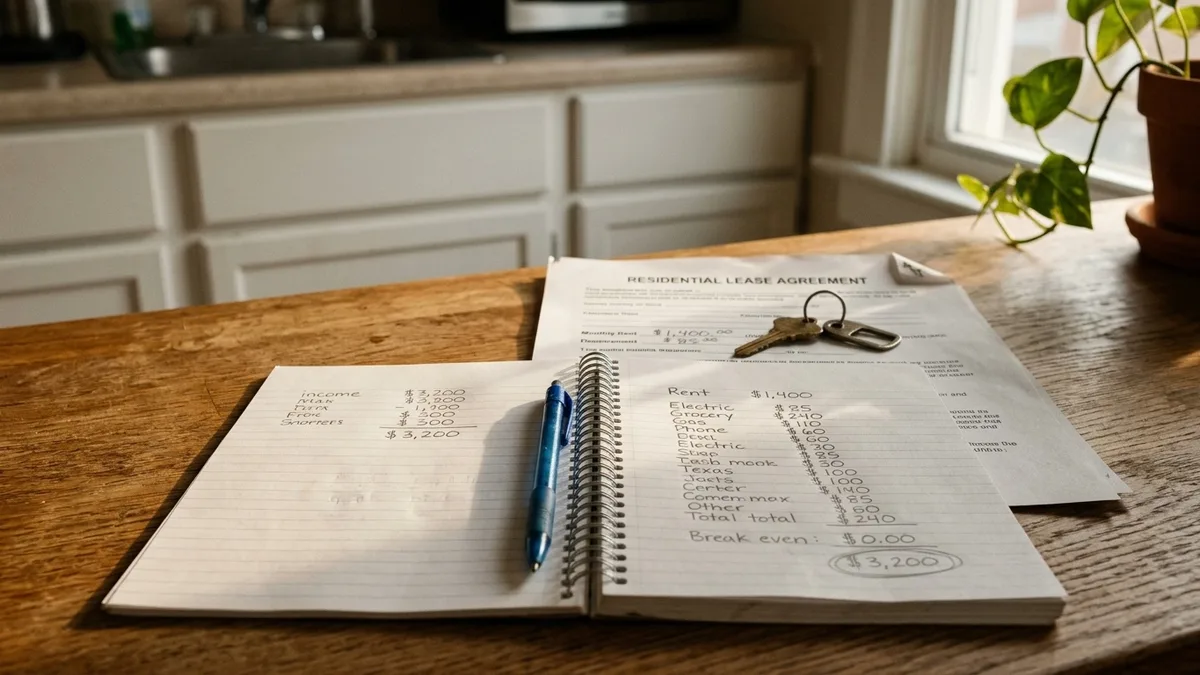
By the last paragraph you will have a break-even number of your own, and it starts with two real listings. The two-bedroom apartment down the street asks $2,200 a month. The comparable two-bedroom house a few blocks over lists at $400,000. Same bedrooms, same town, wildly different cash flow, and the same tired line following you around: renting is throwing money away.
That line survives because the comparison stops too early. A mortgage quote covers principal and interest only. Put 10% down on the $400,000 house and you carry a $360,000 mortgage whose payment moves with whatever rate you lock in, then stack property taxes, insurance, HOA dues, and maintenance on top of it. Rent is one number that already contains all of that.
What rent never does is build equity, and buying only builds it after $52,000 at the closing table and roughly $24,000 in selling costs come back out. Renting buys housing with the repair call handed to someone else and the exit already priced in. Buying can win, but only once those two lump sums are recovered, so the honest test is total monthly cost and a break-even run on your own numbers.
Quick Tips Before You Start
Insure the right side
Renter's insurance runs about $180 a year. Homeowner's coverage on the same two-bedroom: about $1,800. That $1,620 gap belongs in your monthly comparison, not your memory.
Budget the silent 1%
Set aside 1% of the home's value annually for maintenance: $4,000 a year, or $333 a month on the $400,000 house. Rent hides this inside one payment; ownership hands you the invoice.
Know what fixed really means
A fixed-rate principal and interest payment never moves. Property taxes and insurance do — they reset annually and can rise even when your rate is locked.
Set your years, then subtract
Write your expected stay in years. Divide the $52,000 upfront by that number, add the monthly ownership gap, and compare it to rent. Under three years, the lump sums rarely clear.
Quote the rate, not a guess
Get a current lender quote for the $360,000 mortgage before you run anything. A rate you invent produces a break-even number that means nothing.
The Monthly Math
Every rent-vs-buy argument starts with the monthly payment, and that is exactly where it goes wrong. A rent payment is the whole bill; a mortgage payment is the first line of one.
This theme takes the monthly number apart, line by line, until the $2,200 rent and the owning cost can stand next to each other honestly.
1. Rent Is the Ceiling; Mortgage Is the Floor

That $2,200 rent check covers the right to live in the two-bedroom apartment, full stop.
When the dishwasher leaks or the furnace quits, you call the landlord and the repair comes out of someone else's account. No separate maintenance bill lands in your mailbox, no contractor hands you an estimate for a job you now own.
Run the same address as a purchase and the comparison shifts shape. A comparable $400,000 two-bedroom house with 10% down leaves you $40,000 lighter at closing and holding a $360,000 mortgage, and the monthly principal-and-interest figure on that loan swings widely with the rate you qualify for. Pull a current quote before you write any number down.
That mortgage payment is a floor, not a ceiling. Property tax, homeowner's insurance, HOA dues if the place has them, and a maintenance budget all stack on top of it, each one a bill the landlord currently absorbs.
So the honest version of the rent-is-wasted argument puts $2,200 all-in against the full cost of owning, not the mortgage quote alone.
Compare the two like that and the gap between them shrinks fast, sometimes vanishing altogether.
💡 Tip: Ask each lender for the monthly figure including escrowed taxes and insurance, not just principal and interest.
| Cost item | Renting | Buying |
|---|---|---|
| Monthly housing payment | $2,200 all-in rent | Principal and interest on a $360,000 mortgage, rate dependent |
| Upfront cash | $2,200 security deposit, usually refundable | $40,000 down (10%) + $12,000 closing = $52,000 |
| Repairs and maintenance | $0 beyond rent; landlord handles covered repairs | About $4,000 a year (1% of value) |
| Insurance | Renter's: about $180 a year | Homeowner's: about $1,800 a year |
| Property tax | Indirect, baked into rent | Billed directly by the county |
| Cost to leave | Lease end; early-termination terms per lease | About 6% of price, roughly $24,000 |
2. Repairs: A Phone Call vs $4,000 a Year
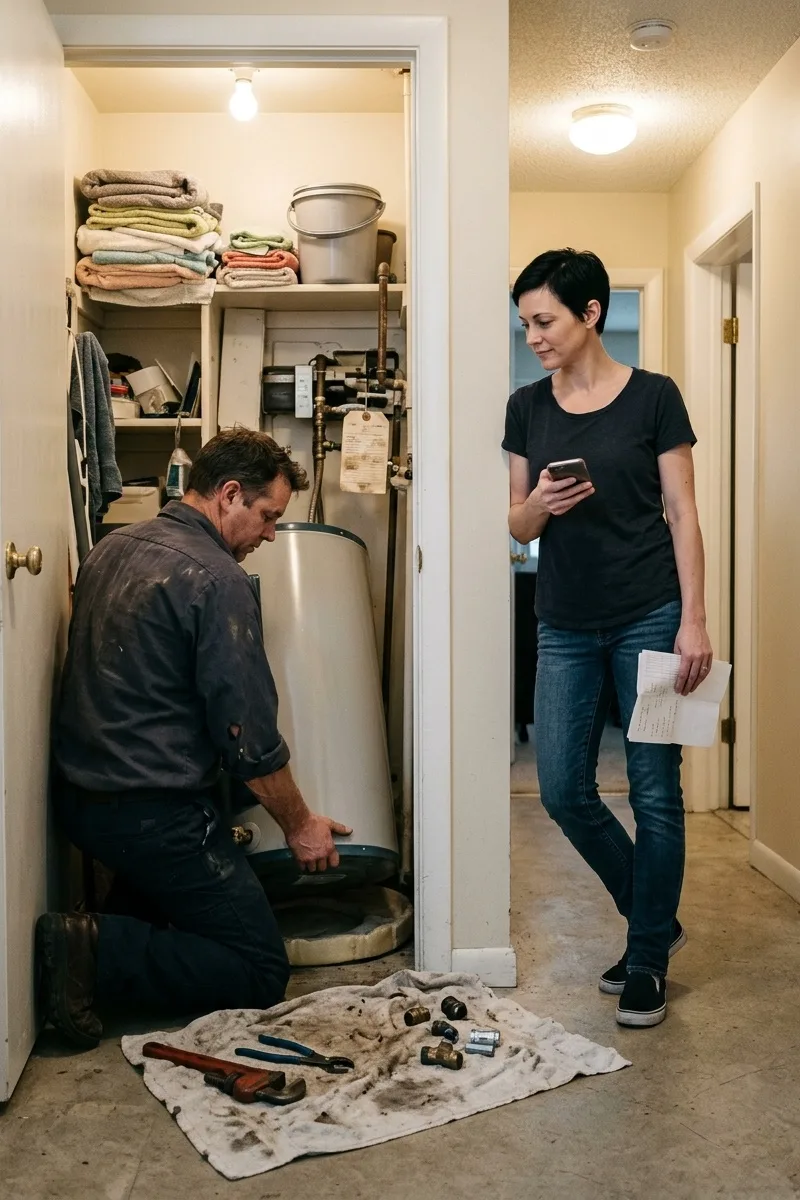
A failed water heater is a phone call for a renter and a four-figure invoice for an owner.
The mortgage is only the floor of what owning costs, and repair bills sit squarely above it. Beyond rent, the renter pays nothing for covered fixes: the leaking roof, the dead furnace, the burst pipe behind the drywall all route to the landlord, and the plumbing crew shows up on his account, not yours.
An owner of a $400,000 home should budget roughly $4,000 a year for maintenance and repairs, which is 1% of the property's value set aside every single year, not a one-time cushion you build and forget.
Some years run cheap and quiet. Others arrive all at once: a new roof near $8,000, a replacement HVAC system around $6,000, and nothing stops both from landing in the same twelve months, which turns an ordinary spring into a $14,000 hit.
Spread across the calendar, that $4,000 works out to about $333 a month of owning cost.
The $2,200 rent already swallows it.
Three Costly Shortcuts
3. Insurance: $15 a Month vs $150 a Month

Skipping renter's insurance to save money is a bad trade at $15 a month.
Repairs are the owner's unpredictable bill; insurance is the predictable premium that follows the deed, and it lands on the owning side whether or not anything breaks. Renter's insurance runs about $180 a year, roughly $15 a month, and it covers your belongings and your liability if someone is hurt inside the apartment.
What it does not cover is the building itself, because the landlord carries that policy.
Homeowner's insurance on the $400,000 house runs about $1,800 a year, or $150 a month, and it covers the structure along with liability. Do the subtraction and the gap is about $1,620 a year, $135 a month, added to the owning column before a single property tax dollar or repair bill shows up.
The small renter premium is not proof the coverage is pointless; it is proof the renter is not paying to insure a building he does not own.
The owner's $150 is simply another layer of the true monthly cost that the mortgage quote leaves out.
💡 Tip: Bundle renter's insurance with your car policy; the multi-policy discount often drops it under $15 a month.
The Upfront and Exit Costs
Monthly math hides the two biggest numbers in the whole decision: what you pay to get in, and what you pay to get out.
Renting barely registers on either. Buying does both at once, and those figures decide whether a short stay ever makes sense.
4. Upfront Cash: One Month's Rent vs $52,000

Monthly premiums are pocket change next to the lump sum a purchase demands before the first mortgage payment clears.
The renter hands over a $2,200 security deposit at move-in. That cash is tied up, not gone, and standard lease terms return it when the apartment is left in decent shape. It is a deposit holding your spot, not a fee for walking away with nothing.
The buyer's day-one stack looks nothing like that. Ten percent down on the $400,000 house is $40,000, and closing costs land around $12,000 on top of it, so $52,000 has to be in the account before the keys change hands.
That $12,000 in closing costs never comes back.
Lenders, title companies, appraisers and the county all take a slice at the closing table, and none of it rides along into your equity. When you sell, you pay a fresh set of closing costs on the other end.
Line the two numbers up: $2,200 versus $52,000 is the real cash hurdle, not the monthly payment difference. The deposit returns to the renter at the lease end; the closing costs stay with the lender and the county forever.
For a renter holding a modest savings balance, that gap is the whole decision in one figure.
💡 Tip: Get a Loan Estimate from two lenders and compare the closing-costs page line by line — the fees vary more than the rates.
Renting vs Buying — At a Glance
🏠 Comparable home
$400,000, 2 bed
💵 Upfront to buy
$52,000
🔑 Upfront to rent
$2,200 deposit
🔧 Repairs per year
About $4,000
🚪 Cost to sell
About $24,000
The number that matters
You need to recover roughly $76,000 in upfront and exit costs before owning pulls ahead.
5. Moving: A Lease End vs a 6% Selling Cost

That $52,000 cash hurdle only stings in full when the stay runs short, because selling early adds a cost most buyers never price in.
Renters sign a 12-month lease, and the exit point arrives on a known date. When the lease ends, packing up costs a truck rental and a Saturday, nothing more. Early-termination terms vary from lease to lease, so read that clause before signing, but the timeline is fixed and visible.
Selling the $400,000 house is a different exit. Agent commissions and fees run about 6% of the sale price, so $24,000 comes off the top before you see a dollar.
That number lands whether the house rose or fell.
Add the two figures together: $52,000 in upfront costs plus $24,000 at sale, and the house has to appreciate enough to clear $76,000 before the buyer is back where a renter stood on day one. Move in year two and the math rarely gets there.
Flexibility is a priced feature, not a vague feeling. A lease end is a clean exit; a sale carries $24,000 in costs, so a short stay tips the comparison toward renting.
If a job transfer, a growing family, or a relationship change is plausible within a few years, price the exit before you buy the entry.
⚠️ COMMON MISTAKE
Don't Skip the Exit Clause
Comparing a $2,200 rent to a mortgage payment without reading the lease's early-termination terms and the 6% selling cost means you are comparing two numbers that ignore how you leave. The exit is half the decision.
The Money You Don't See
Some costs never appear on a monthly statement: equity that grows slower than people expect, cash that could have been working elsewhere, and a tax bill that renters pay without ever seeing it.
This is where the myth does its most damage, because these are the costs nobody puts in the brochure.
6. Equity Builds Slowly and Only After Costs

All those upfront and exit costs are the reason the equity headline falls apart under scrutiny.
Rent buys housing for the month, nothing else. Buying builds equity two ways: the principal portion of each payment reduces the loan balance, and the home's value moves with the market. Both are real, and both arrive slowly at the start.
On a $360,000 mortgage, the early years are mostly interest. A fixed principal-and-interest payment stays the same, but in year one the principal slice is a thin sliver of each check, so the loan balance barely budges. Equity builds steadily over a decade, not overnight.
Then subtract what the buyer already spent to get in and will spend to get out. The $52,000 in upfront costs is gone from the equation, and $24,000 in selling costs comes off any gain at the end.
If the house sells for $430,000 after a few years, the $30,000 gross gain shrinks fast once the $24,000 exit bill and the original $52,000 are counted.
Equity is what is left after those costs, not the sale price on the listing.
Owning builds wealth over a long hold in a stable market, and early buying is no instant wealth machine. Run the net figure before treating a mortgage as a savings plan.
💡 Tip: Ask your lender for the amortization schedule and read the principal column for the first 24 months.
Where the $400,000 House Money Goes
7. The $52,000 Down Payment Could Earn Elsewhere

Equity is not the only thing riding on that $52,000 pile. The moment it leaves your account for a down payment and closing costs, every other use of that cash stops being available to you.
A renter who keeps the $52,000 in a taxable brokerage account, a high-yield savings account, or a retirement contribution has a decision to make that a buyer has already made for them. The buyer's $52,000 is in the walls, the roof, and the county's records office.
That is not an argument against buying. It is an argument against leaving the number out of the comparison.
Home appreciation is not guaranteed, and neither is an investment return. The honest version of this comparison uses today's actual options: get the current high-yield savings rate, the current mortgage rate quote, and the current local price trend, and put them side by side. Assumed returns in either direction are just guesses dressed as math.
There is one more difference worth naming. The $52,000 in an index fund can be sold on a Tuesday afternoon and the cash is in your checking account by Thursday. The $52,000 in the house comes back only when you sell the house or borrow against it, and borrowing against it means a payment.
For a renter with $52,000 sitting in a savings account earning 4%, the annual interest is about $2,080, or roughly a month of the $2,200 rent. That number does not decide the question. It does mean the rent is not the only cost the cash is carrying.
The full column for owning, then, runs installment-style: monthly principal and interest, taxes, insurance, and maintenance on the bottom line, $52,000 sunk at the top, and the foregone return on that cash running alongside the whole thing.
8. Property Taxes: The Owner's Bill, Baked Into Rent

Renters do pay property taxes. They pay them in the rent check, not in a separate county envelope, and that distinction matters more than it sounds.
The owner of the $400,000 house gets a bill from the county assessor every year, and it can arrive as a single annual payment or as twelve escrowed installments folded into the mortgage. The landlord of the $2,200 apartment gets the same kind of bill for the building and sets rent with that number in the spreadsheet.
So the $2,200 rent already contains a property-tax component. The renter's mistake is not failing to pay it; the mistake is thinking the $2,200 and the owner's mortgage payment are the same kind of number.
The owner's tax bill sits on top of principal and interest. When you line up the two columns, the $2,200 rent goes against mortgage payment plus tax plus insurance plus maintenance, and the tax line is the one renters keep forgetting to add.
What the bill comes to depends entirely on the address. A county assessor's website takes a parcel number and returns an assessed value, a mill rate, and the annual tax figure. Pull it for any house you are considering before you run the monthly owning cost.
In a high-tax county the annual bill on a $400,000 home can run several thousand dollars; in a low-tax county it may be a fraction of that. Same house, same mortgage, different bottom line.
The honest read for a renter: the $2,200 is not tax-free housing. It is housing with the tax already inside it, paid through the landlord instead of the assessor.
💡 Tip: Pull three years of tax history for any house you tour — a reassessment can change the monthly payment after closing.
Renting or Buying — Which Side You're On
Renting Wins When
- You will stay under three years
- You have under $52,000 in liquid cash
- Your job or relationship may move you
- You would rather not carry a $4,000-a-year repair budget
- You want a fixed monthly number with a known exit
Buying Wins When
- You will stay well past break-even
- You have $52,000 plus a reserve for repairs
- Your income and location are stable
- You want control over the walls and the yard
- You can absorb a tax or insurance increase
The Time Test
Everything above changes with one variable: how long you stay. Rent moves with renewals, a fixed mortgage does not, and taxes and insurance move regardless of what the mortgage does.
This theme puts both costs on a clock and ends with the number that decides the whole question.
9. Rent Can Rise Yearly; a Fixed Payment Cannot

The property-tax bill is not a fixed number, and neither is the rent. Time changes both sides, just not in the same way or at the same moment.
A fixed-rate mortgage locks the principal-and-interest figure for the life of the loan. If the quote today is $2,100 a month, that slice of the payment is still $2,100 in year ten. That is the genuine advantage of owning on a fixed rate, and it deserves to be stated plainly.
But the rest of the owning bill keeps moving. County assessors reassess on their own schedule, and a reassessment can push the tax line up or down. Homeowner's insurance premiums reset at renewal, and in a market with rising repair costs they reset upward. The total monthly cost of owning has a fixed floor and a moving ceiling.
Rent moves too. The lease fixes the number for its term, and at renewal the landlord can propose an increase. How much is allowed, and how much notice is required, depends on the lease and on local rules, so read the renewal clause and check the local ordinance before signing a twelve-month term.
For a renter weighing a purchase, the honest framing is a race between two risks over the same years. Rent carries renewal risk: the number can jump while you are still living in the same rooms. Owning carries tax and insurance risk: the fixed payment buys less of the total bill as those lines climb.
A long stay favors the fixed slice, because thirty years of unchanged principal and interest is a real hedge. A short stay does not get to collect that hedge, and the risk on the owning side arrives before the benefit does.
🧮 Find Your Break-Even in Five Steps
Count the years first
Under five years, the $52,000 upfront rarely clears the $24,000 exit cost. Over ten, the fixed slice starts paying you back.
Separate the locked slice
Get a current rate quote for the $360,000 mortgage, then write the principal-and-interest figure in ink. The other lines get pencil.
Budget the moving lines
Add $4,000 a year in repairs, about $1,800 for homeowner's insurance and the county's tax bill. That total is your ceiling, not your payment.
Weigh rent's real bill
$2,200 a month plus $180 a year in renter's insurance. The $2,200 deposit is refundable, so it does not enter the comparison.
Find the crossing year
Feed all of it into a rent-vs-buy tool with local tax and insurance inputs. The year owning's cumulative cost drops below renting's is your number.
10. The Break-Even Point Is the Number That Matters

Renewal risk on rent, tax-and-insurance risk on a mortgage – which one costs more depends on one thing nobody quotes you: how long you stay put.
The break-even is the year your total cost of owning finally drops below your total cost of renting. Below it, the $52,000 you handed over at closing plus the roughly $24,000 a sale takes off the top haven't been recovered, and the house has cost you more than the apartment would have. Above it, the math flips in the owner's favor. Every year on the right side of that line is the payoff; every year on the left is the price of buying too soon.
Run the two sides against each other in full. Owning is mortgage principal and interest on the $360,000 loan, plus property tax, plus the $1,800-a-year insurance premium, plus the $4,000 maintenance budget, plus HOA dues if the house has them. Renting is $2,200, all in.
Pull a current mortgage quote and your county's actual tax rate before you touch a calculator. A rate half a point higher stretches the break-even by a year or more, and a high-tax county can add thousands a year to the owning side that no national average shows.
For this reader, a short stay favors renting – plainly. Sell the $400,000 house in year three and the $24,000 exit cost eats most of whatever equity the first years built, on top of the $12,000 in closing costs that never come back. Stay a decade and the arithmetic turns.
The honest answer to how long is not a rule of thumb off a website. It is the year your own rent, price, rate, and local taxes put you past $76,000 in sunk costs – and only you can run that number.
💡 Tip: Run the calculator three times with rates a half-point apart — the break-even year shifts more than you expect.
Frequently Asked Questions
Is renting really throwing money away?
No. Rent buys housing, covered repairs and a clean exit. The owner pays for those things too, just through a mortgage, a tax bill, an insurance premium and a repair fund instead of one check. The honest comparison is total cost against total cost, not rent against a mortgage quote.
How much cash do I need to buy a $400,000 house?
Plan on about $52,000: $40,000 for a 10% down payment plus roughly $12,000 in closing costs. Closing costs are sunk and do not come back when you sell, so count them fully in your break-even math.
How long do I need to stay for buying to beat renting?
Long enough to recover the upfront and exit costs — $52,000 in and about $24,000 out on this example — while paying a higher monthly cost than rent. That is usually several years. Run a rent-vs-buy calculator with your current mortgage rate and local taxes to get your own year.
What does renter's insurance actually cover?
Your belongings and your liability, for about $180 a year. It does not cover the building, because the landlord insures the structure. Homeowner's insurance on the same $400,000 property runs about $1,800 a year because it covers the building too.
Do renters pay property taxes?
Indirectly. The owner gets the county bill and builds it into the rent, so part of your $2,200 is property tax. What renters avoid is the direct exposure to a reassessment raising the bill after move-in.
What is the first number I should check?
The full monthly cost of owning beyond the mortgage payment: property tax, homeowner's insurance, HOA dues if any, and about $4,000 a year in maintenance. That total, not the mortgage quote, is what your $2,200 rent needs to be compared against.
The Verdict Renting Deserves
The verdict is plain: renting wins for short stays, thin cash reserves, and anyone who needs a clean exit. Buying wins for long stays and stable roots, once the $52,000 is sitting there and there is a reserve set aside for the $4,000 repair years. That is a verdict about your circumstances, not about whether rent is waste.
This week, run a rent-vs-buy calculator with your own rent, purchase price, current mortgage quote, and county tax rate. Check the number that decides most of it first: the monthly cost of owning past principal and interest, meaning taxes, insurance, maintenance, and HOA dues if any.
The $2,200 rent is not vanished money. It buys housing with a phone call fix and a lease-end exit, while the $400,000 house's mortgage is a floor beneath $52,000 upfront and $24,000 to sell. The myth was never that renting is free or buying is bad. It is that one slogan hides a personal break-even and a full-cost comparison, so run yours before you sign anything.
Check the Number Beyond the Mortgage
Add property tax, homeowner's insurance and about $4,000 a year in repairs to your mortgage quote right now. That total is the one your rent actually competes with.