
Your suitcase lives on top of the wardrobe, your winter coats are folded into a laundry basket, and the bed sits in the middle of the room like an island. Typing “storage bed frames small bedroom” into a search bar brings up hundreds of look-alikes, and almost none of them tell you what they ask of your floor.
The goal isn’t more furniture. It’s a bed that quietly absorbs the overflow while you still get from the door to the window without turning sideways. Which type does that best depends on what you store, how often you grab it, and whether your tight dimension is width or length.
Below are eight looks, starting with the swaps that need the least effort and ending with the ones that rearrange your room. Each gets a formula, a clearance figure, and a note on where to save and where to spend.
1. Raised Frame With Rolling Crates
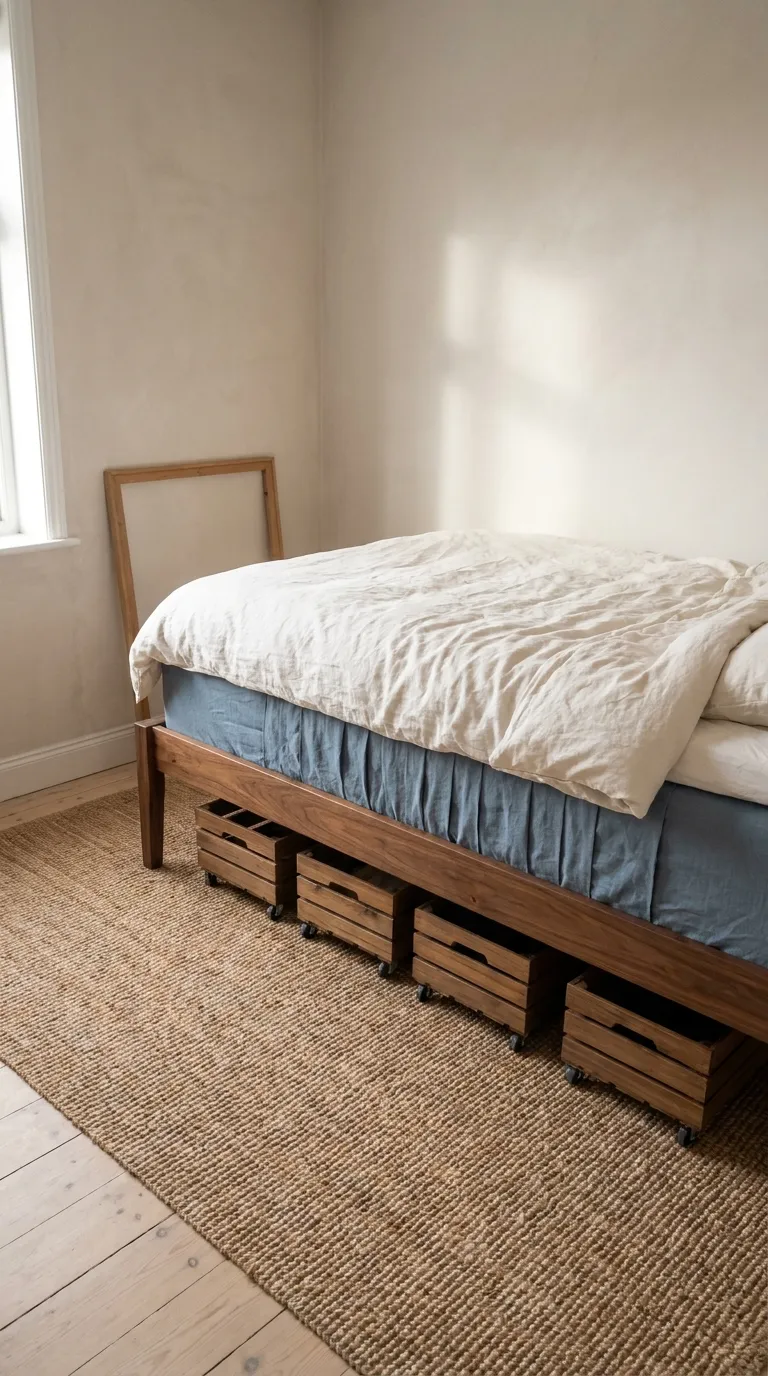
Renting means everything you buy has to survive the next move. A tall frame with nothing built in is the easiest case, because the empty space beneath it becomes whatever you need it to be this year.
The Formula
- Anchor: bed frame set high enough for containers to slide beneath
- Support: three or four low wheeled crates in one finish
- Accent: pleated valance in dusty blue along the front rail
Why It Works
Wheeled crates turn the dark gap into a filing system: shoes in one, spare linens in another, scarves in a third. Because you pick the containers, you can swap them whenever your belongings change. Open space does gather dust, so run a cloth across the floor each time you reshuffle.
Space Needed
Hold a tape measure between the floor and the underside of the rails. Subtract about 1 inch and you have the tallest crate that will roll freely. A crate also needs somewhere to go once it’s out, and 24 inches of aisle along that side gives it room. Outline the bed on the floor with painter’s tape and walk around the shape once before you order.
Save or Invest
- Save on: the containers, since basic ones roll and stack as well as fancier versions
- Invest in: solid joints and well-spaced slats, because a creak only gets louder
2. Lift-Top Base for Luggage and Duvets
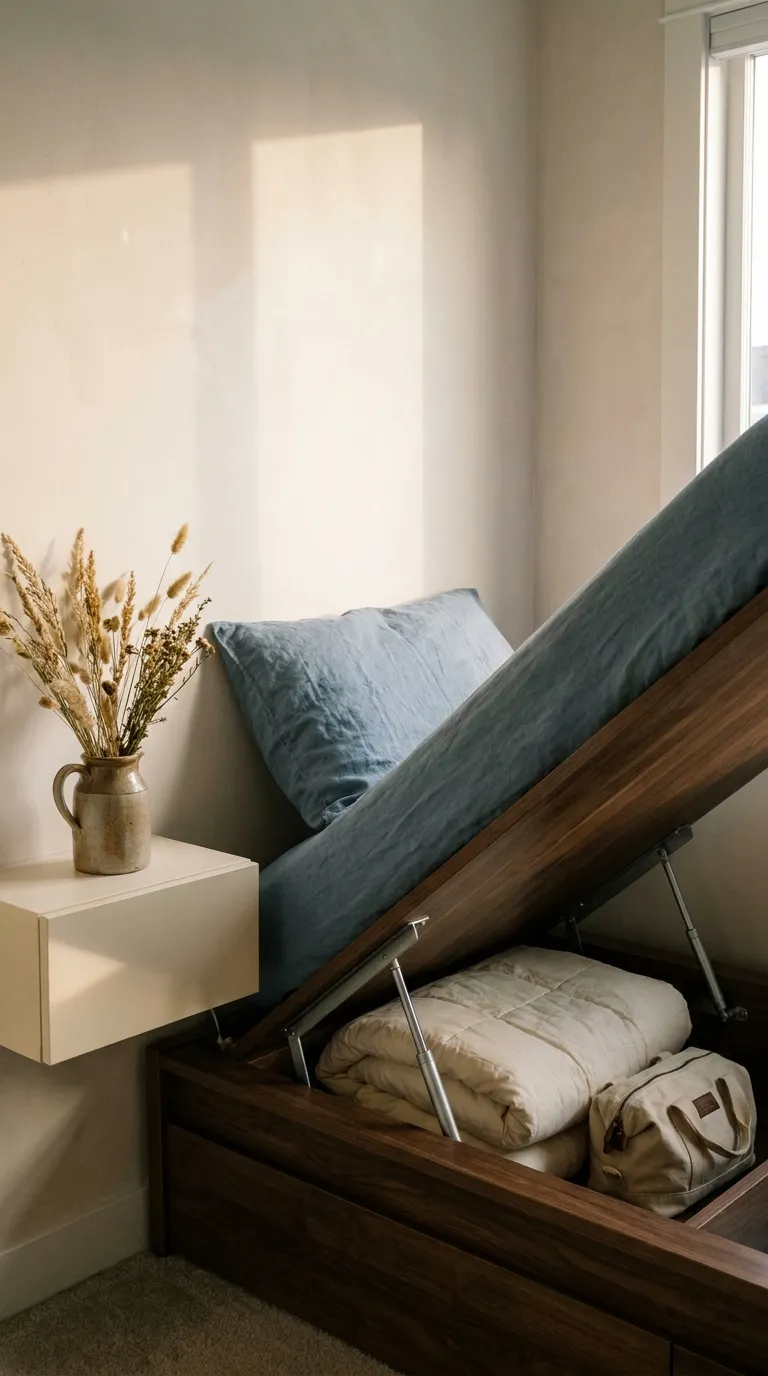
Some overflow is bulky and seasonal rather than daily: a carry-on, a down comforter, the box of holiday linens. For that kind of stuff, a lift-top base swaps many small compartments for one deep one under the entire mattress.
The Formula
- Anchor: frame whose mattress platform tilts up on gas struts
- Support: two or three zip-top storage bags that keep layers separate
- Accent: stoneware pitcher of dried stems on the bedside surface
Why It Works
Deep storage swallows what drawers never could, and the lid closes flat, so nothing intrudes on the room. It does ask for a small effort each time, because you hoist the mattress to reach anything below.
Space Needed
The platform swings up from one side or from the foot, and that arc needs about 24 inches of open air. A wall or a tall dresser in the way will stop it halfway. Delivery is a separate hurdle: these frames are long and heavy, and a typical interior doorway runs near 30 inches, with hallways in older buildings often tighter. Before you pay, ask one thing: will it fit past the lobby, up the stairs, and through the bedroom door? Compare the listing’s measurements with the narrowest point between the street and your bed.
Enter the frame’s measurements and your doorway width below.
Save or Invest
- Save on: fabric choice and finish, since bedding hides most of the frame
- Invest in: quality gas struts, because they take the mattress’s weight at every lift
3. Side-Drawer Frame for Daily Clothes
Closets in small bedrooms fill up first. Building drawers into the base moves your sweaters and gym clothes into floor space the bed already occupies, so no dresser has to squeeze in.
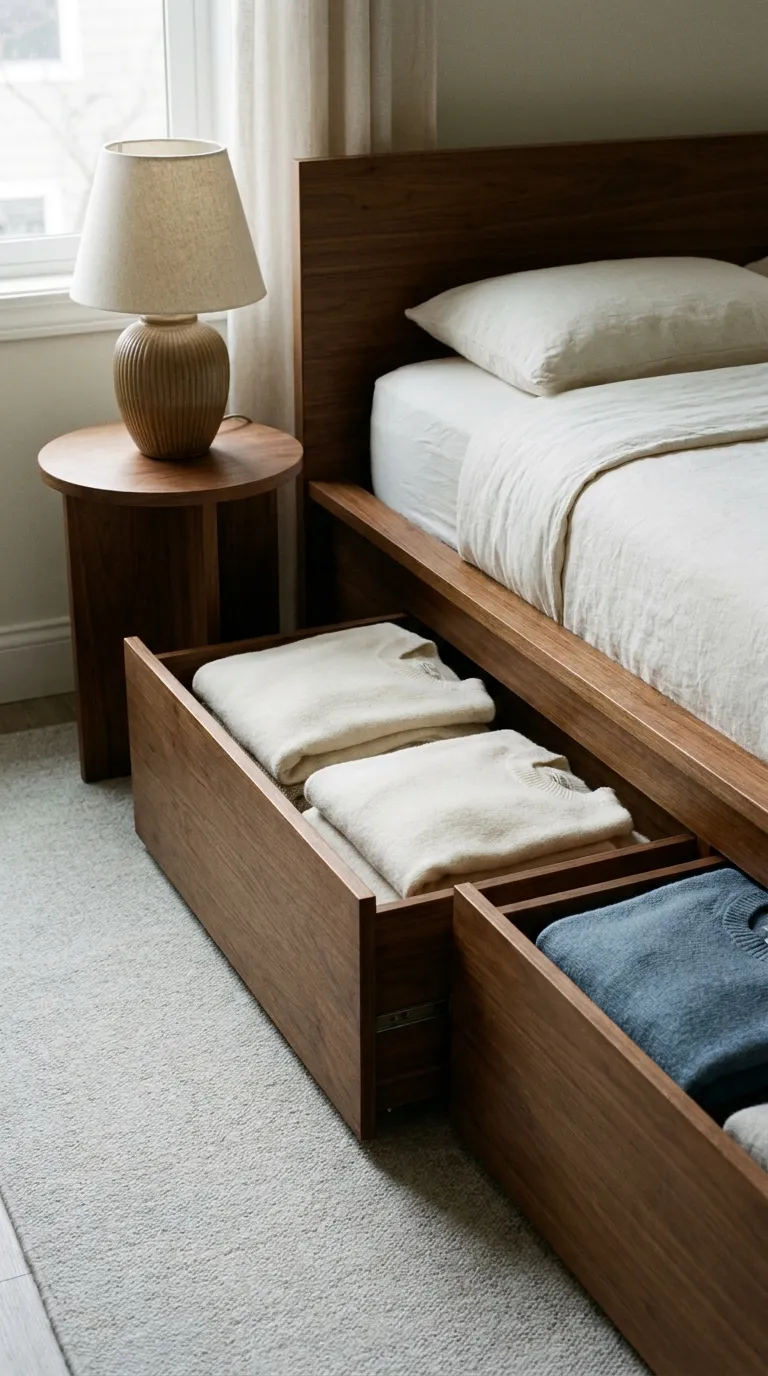
The Formula
- Anchor: low platform base with deep drawers along a long side
- Support: stool or small stacking table beside the pillow
- Accent: lamp with a woven shade in warm white
Why It Works
Drawers under a platform replace an entire dresser without enlarging the footprint. Sitting low also lets your eye travel past the bed to the far wall, which makes the space feel longer.
Space Needed
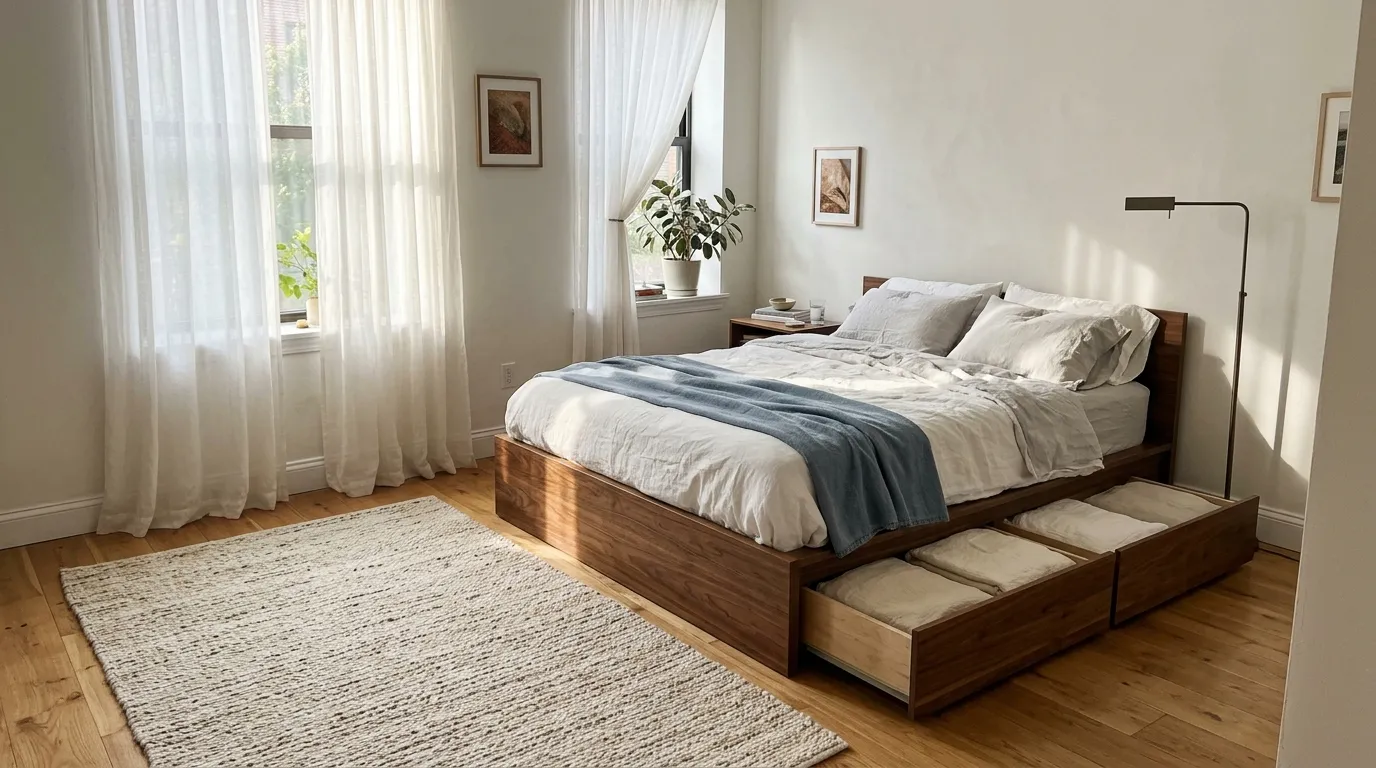
Drawers need travel room, about 24 inches in front of each one. Picture a room 108 inches wide with a 38-inch bed: that leaves 70 inches. One drawer side takes 24 of them and leaves plenty to walk, but drawers on both sides ask for 48 inches in total and leave far less. In a narrow room, choose a single side.
Save or Invest
- Save on: a second nightstand, because a stool covers the job
- Invest in: full-extension glides, since they let each drawer pull out far enough to reach the back
4. Twin Frame Tucked Into a Corner
Pushing a single bed against two walls feels like giving something up, but it hands most of the room back. The aisle shifts to one side, and the far end of the room is free for a chair, a rug, or a narrow dresser.
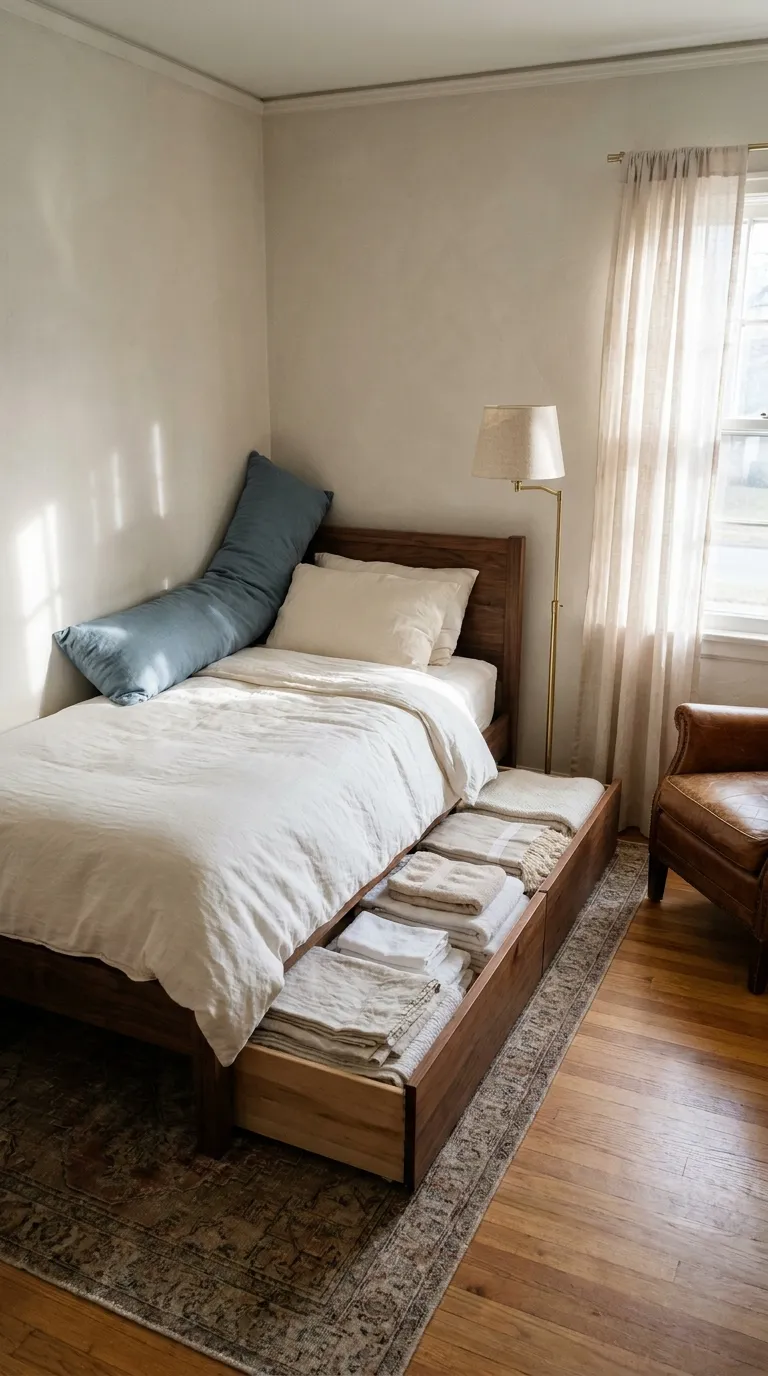
The Formula
- Anchor: single bed frame fitted with one full-length drawer
- Support: slim arc lamp standing at the open end
- Accent: dusty blue bolster wedged into the corner
Why It Works
With walls on two sides, only one edge of the bed needs walking space. Bed-making is the price: with two edges against walls, you will be wrestling a fitted sheet into tight spots.
Space Needed
Standard twin mattresses run 38 inches across and 75 inches from head to foot. Reserve 24 inches along the open side, and pick a frame whose drawer slides toward that aisle instead of into a wall.
Save or Invest
- Save on: a decorative headboard, because the corner hides half of it
- Invest in: smooth glides on that single drawer, since it holds everything
5. Bookcase Headboard Frame
A nightstand eats floor, but the wall behind your pillow is empty. A frame with shelves or a cabinet at the head uses that vertical strip for books, a lamp, and a water glass, and it often lets you drop the nightstand altogether.
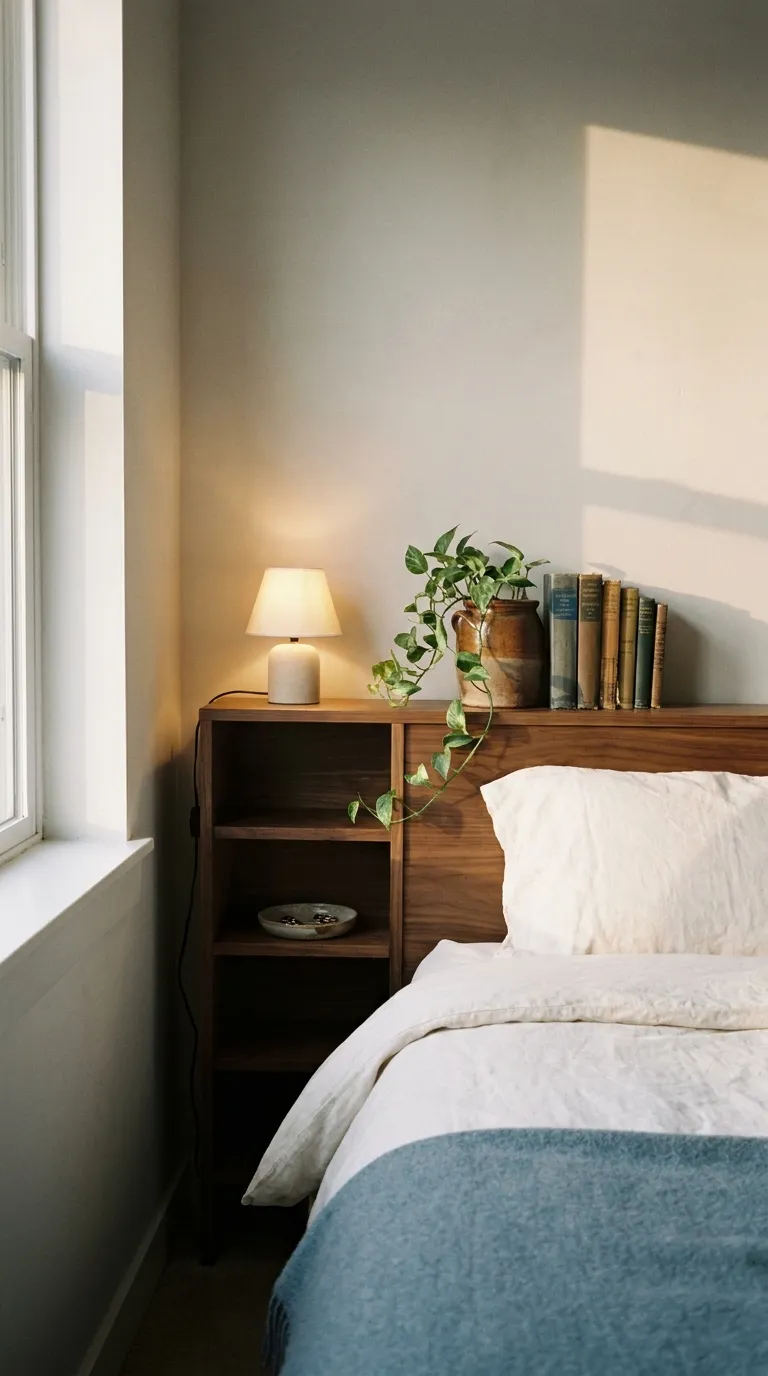
The Formula
- Anchor: frame with a shelving unit built into the head end
- Support: corded reading lamp resting on the top shelf
- Accent: ceramic dish for earrings and hair ties
Why It Works
This look stacks storage upward, which spares the floor and keeps your bedtime essentials within arm’s reach.
Space Needed
Before ordering, measure from the wall to the bedroom door. An integrated shelf unit adds roughly 8 to 10 inches to the bed’s total length, so check what walkway remains. Beside the bed, nothing changes from a plain frame.
Save or Invest
- Save on: a wall of cubbies, since a couple of open shelves cover the nightly basics
- Invest in: a thick back panel that won’t flex under books and a lamp
Renter-Friendly Swap
Rental walls are off limits unless your lease says otherwise. A unit that bolts onto the bed itself keeps the paint intact, and felt pads on its feet protect the floor. Tall pieces can tip, so follow the maker’s directions and use wall anchors rated for the load.
6. Daybed That Doubles as a Sofa
A bedroom can host a guest only if it has somewhere to sit. A daybed gives you a sofa by day and a bed by night, and the trundle drawers beneath hold bedding or clothes.
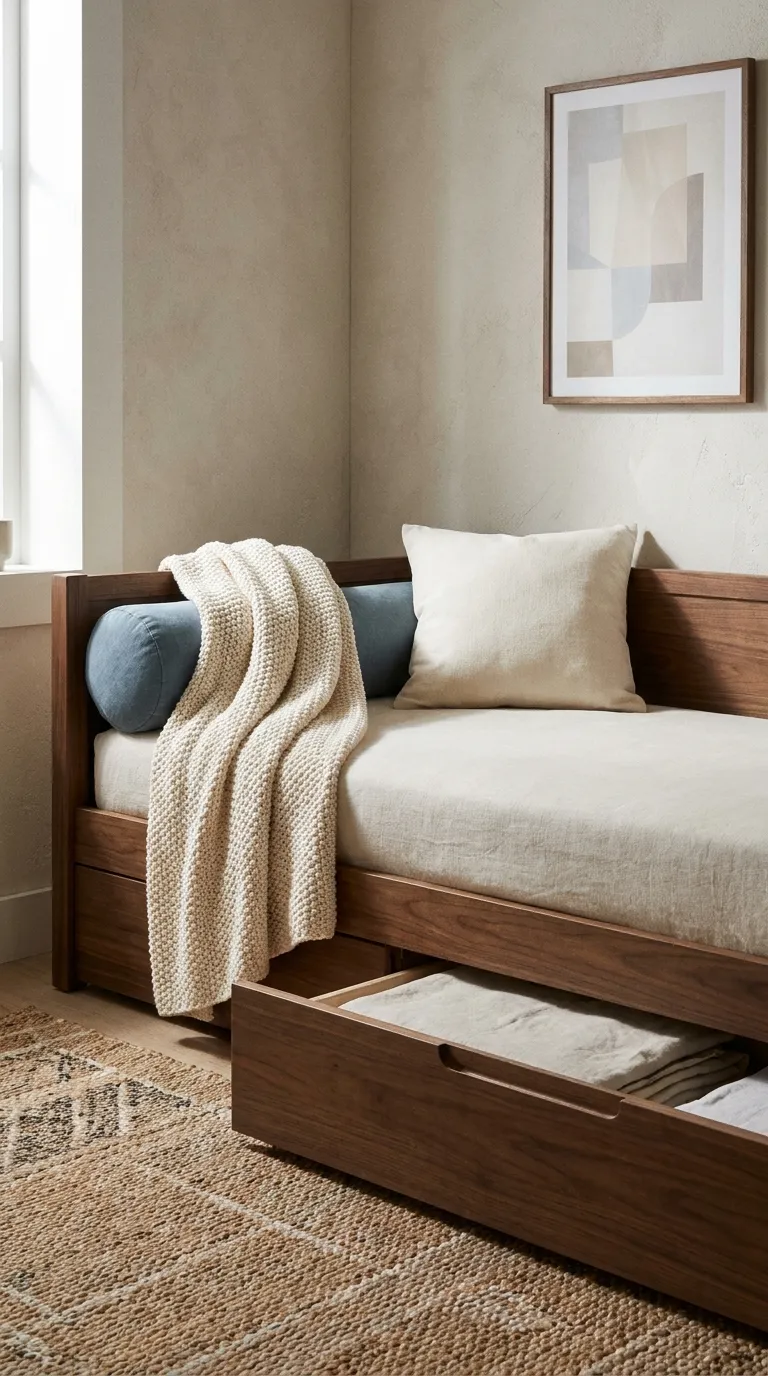
The Formula
- Anchor: sofa-height daybed with trundle drawers tucked below
- Support: two bolsters and one square cushion for the back
- Accent: chunky knit blanket across one arm
Why It Works
Set along the longest wall, a daybed reads as seating, and the middle of the room stays clear for walking. You also skip buying a separate chair.
Space Needed
It uses the same twin footprint described in the corner look, plus a few inches for the arms and back. Keep 24 inches free at the front so the trundle drawers can roll out completely.
Try it: pick a look, type in your room’s width and length, and see whether the floor can handle the clearance.
Save or Invest
- Save on: cushions beyond the first few
- Invest in: a dense, well-braced slat base that handles sitting and sleeping
7. Loft Frame With a Work Nook Below
When the floor is too small for both a bed and a desk, one of them has to go up. A loft frame lifts the mattress overhead so a desk, a dresser, or a reading chair can live beneath, provided the ceiling is tall enough.
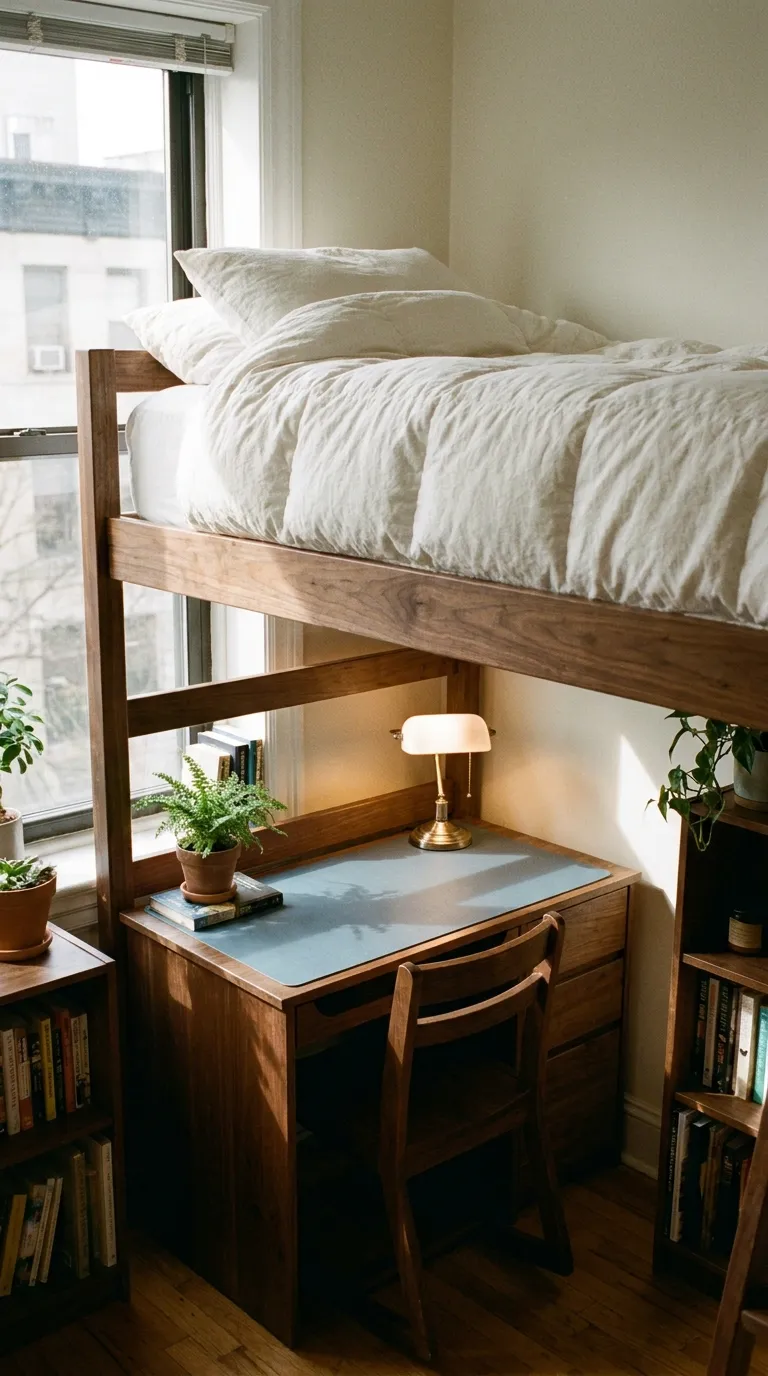
The Formula
- Anchor: raised sleeping platform reached by a ladder or steps, with guard rails
- Support: slim desk or low dresser below
- Accent: plug-in desk lamp in warm white
Why It Works
Stacking the sleeping zone above the working zone turns one room into two. You pay for it with a climb each night, and changing sheets overhead is awkward.
Space Needed
Ceiling height is the deal-breaker, so read the manufacturer’s minimum before you click buy. Underneath, a desk about 24 inches deep, plus space to push the chair back, makes a workable setup.
Save or Invest
- Save on: the furniture beneath it, since a plain desk or a secondhand dresser does the job
- Invest in: rails, rungs, and joints, because this is the one piece you sleep on above the ground
Renter-Friendly Swap
Anything fixed to a wall or ceiling needs your landlord’s okay and a lease check. A freestanding loft stays on its own legs and leaves the walls untouched, so follow the assembly steps exactly. If anchors are required, pick ones rated for the frame’s weight.
8. Fold-Away Wall Bed Cabinet
Folded up, a wall bed looks like a cabinet. By day the room can serve as a workspace or a stretching spot, and by night the bed comes down. It is the heaviest commitment here and the one that returns the most floor.
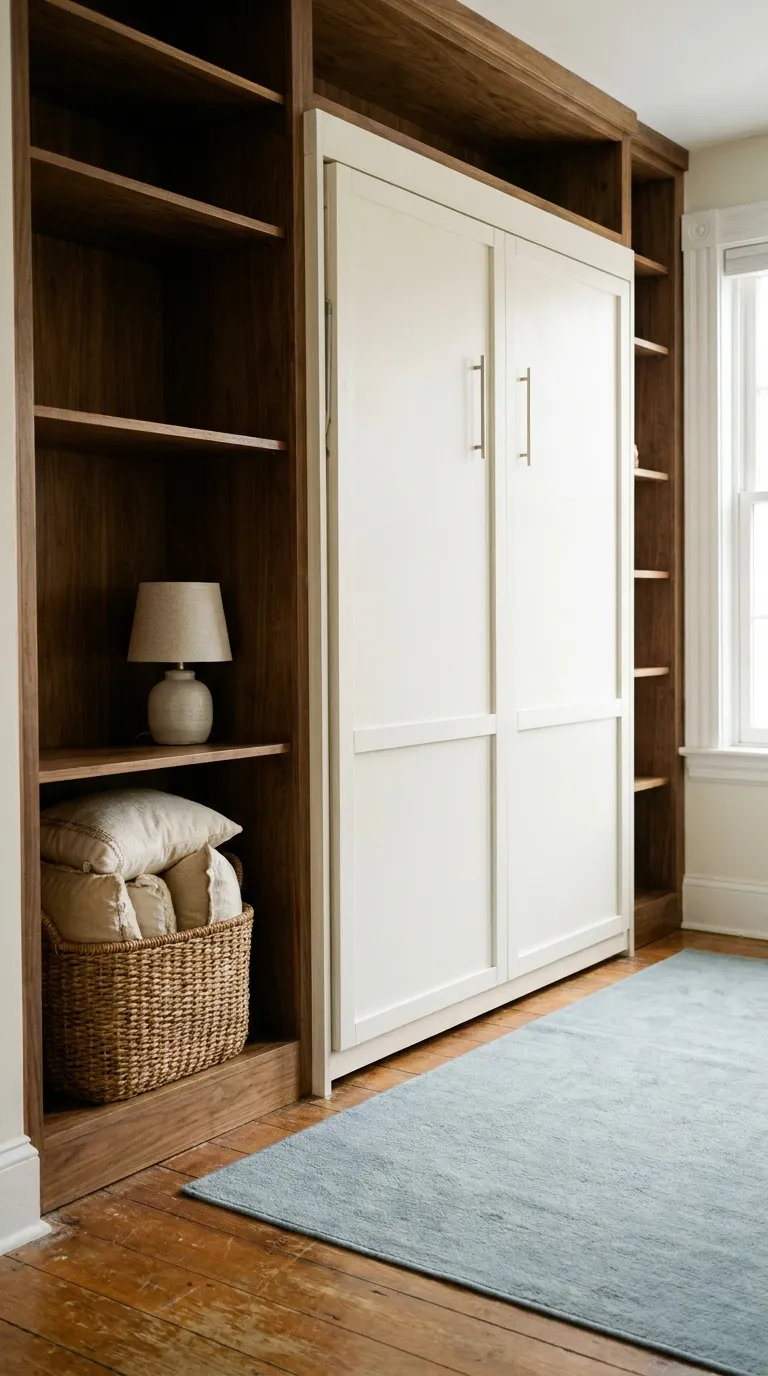
The Formula
- Anchor: fold-up bed hidden behind a cabinet front
- Support: floor-to-ceiling shelving unit beside it
- Accent: woven basket for pillows on the bottom shelf
Why It Works
Putting the bed away gives the whole floor back for the day. Expect a daily fold-and-lower routine, and budget for a careful installation.
Space Needed
Lowered, the bed stretches about 75 inches into the room for a twin, since that is a mattress’s length. Save 24 inches at one side for walking.
Save or Invest
- Save on: the door finish, because a plain painted front looks clean and costs less
- Invest in: the hardware that lifts and holds the bed, since every night depends on it
Renter-Friendly Swap
A wall-mounted unit means holes, so the lease and your landlord come first. Where holes are banned, a cabinet-style model that rests on the floor is the workaround. Either way, follow the maker’s steps, use anchors rated for the unit’s load, and think about hiring a professional installer.
Quick Look Cheat Sheet
Here are all eight looks side by side, in the order they appear above.
| Look | Anchor Piece | Budget Swap |
|---|---|---|
| Raised Frame With Rolling Crates | Tall frame, open underside | Current frame, lifted on risers |
| Lift-Top Base for Luggage and Duvets | Lift-top frame, one cavity | Basic lift-top, bare finish |
| Side-Drawer Frame for Daily Clothes | Platform base with drawers | Low frame, wheeled drawer unit |
| Twin Frame Tucked Into a Corner | Twin frame, long drawer | Twin frame, wheeled shallow box |
| Bookcase Headboard Frame | Frame with shelf headboard | Existing bed, tall narrow bookcase |
| Daybed That Doubles as a Sofa | Daybed with trundle drawers | Twin bed dressed with bolsters |
| Loft Frame With a Work Nook Below | Freestanding loft frame | Entry-level loft, used desk |
| Fold-Away Wall Bed Cabinet | Wall bed cabinet | Entry-level wall bed, separate shelving |
The Formula Behind These Looks
Every look above follows one pattern: a single anchor, a supporting piece or two, and a small accent. Here is why that pattern holds up in a tight room.
Storage Bed Frames Small Bedroom Layouts Can Handle
Think of the bed as the room’s biggest drawer. If it swallows spare bedding and off-season clothes, a dresser or chest may no longer have a reason to stay.
Choose the Frame Before Anything Else
A single large anchor looks calmer than a crowd of small ones. Settle on the frame, then add companions that sit lower and lighter than the bed.
Echo One Tone Across the Room
Dusty blue, warm white, and walnut make an easy trio. When frame, crates, and bedding share a couple of tones, the storage looks planned instead of piled up.
Protect Your Walking Lanes
Aim for at least 24 inches of open floor along one edge of the bed. That gap makes the whole room read as roomier.
Test the Scale With Tape
Every shopping trip should start at home: measure your room wall to wall, then tape the bed’s outline on the floor and circle it. A style that is too big announces itself within a minute.
Common Storage Bed Mistakes Worth Skipping
Most of these are easy to dodge once you know where they hide.
Hitting Buy Before Measuring
A frame that wins in the listing can get wedged on a stair landing. Run its dimensions past every entry, turn, and doorway on the route first.
Letting a Drawer Hit a Wall
Anything that slides or swings needs an empty runway. Reserve 24 inches beside the side that moves, and pick a different look if a wall or a dresser sits there.
Collecting Too Many Small Pieces
A scatter of little organizers can fill a room faster than one big piece. Pick one anchor and let it carry most of the load.
Cutting Off Your Path
Even excellent storage becomes a nuisance if you shuffle sideways every morning. Leave an open lane from the door to the bed, and another from the bed to the closet.
Final Tips for Success
Begin With an Inventory
Sort what you plan to store into piles: bedding, shoes, clothes, luggage. Then pick a frame to suit the piles instead of the other way around.
Skim the Weight Limit and Assembly Notes
The manufacturer’s instructions spell out weight limits and assembly order. Big frames go together faster with a second pair of hands, so invite a friend over.
Basics Worth Owning
- Retractable tape measure
- Roll of painter’s tape
- Felt furniture pads
- Lidded bins in one finish
- Notepad for dimensions
Conclusion
A small bedroom can still feel calm. The right frame gives your belongings a real home and keeps the floor open for living.
Next time “storage bed frames small bedroom” fills your search bar, sort your belongings by how often you touch them first. Daily clothes belong in drawers, seasonal bulk fits a lift-top base, and nightly essentials suit a shelf headboard.
Measure your doorways, tape the footprint, and reserve 24 inches wherever something opens. Those habits count for more than any style choice.
Pin this guide so it’s ready the next time you rearrange the room.